

Welcome to Ph Designs Hub, your source for hair education, beauty tips, styling inspiration, local updates, community connections, and expert insights from Polished Hair Designs in Albuquerque, New Mexico. Enjoy immersive education, personal renewal, practical tips, insightful discussions, entertaining articles. Your Lifestyle beautifully connected.
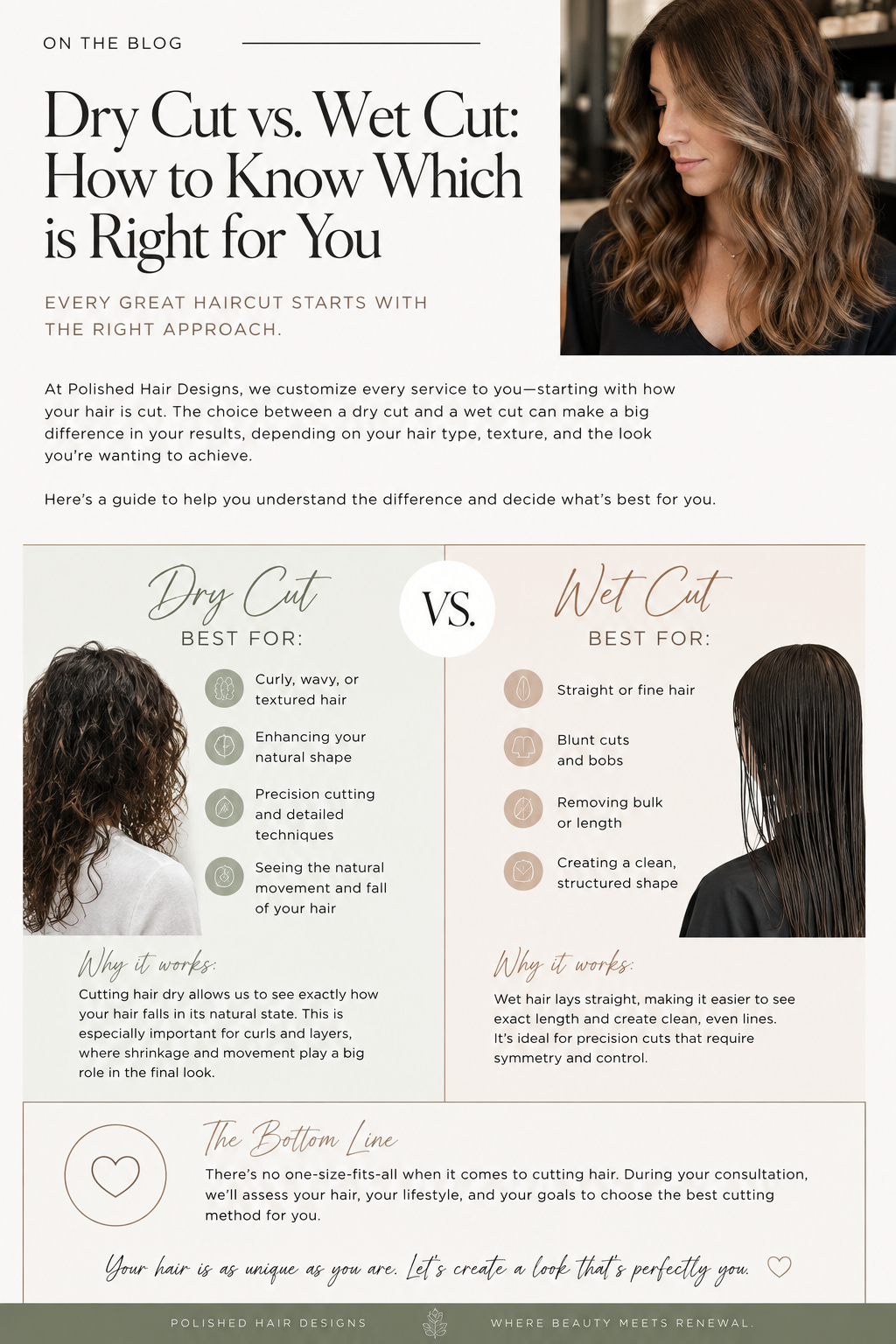
Dry Cut vs. Wet Cut: How to Know Which Is Right for You
When it comes to getting a haircut, you might wonder: Does it really matter if my hair is cut wet or dry?
The answer is yes—but neither method is automatically better. The right approach depends on your hair’s texture, density, shape, and the look you want to create.
At Polished Hair Designs, every haircut is customized to you. Sometimes that means cutting wet, sometimes dry, and sometimes using a combination of both.
✂️ When a Dry Cut May Be the Better Choice
A dry cut allows us to see your hair exactly as it naturally falls.
This can be especially helpful for curly, wavy, or highly textured hair, where shrinkage, movement, and the natural pattern can dramatically change the shape once the hair dries.
A dry cut can be a great choice when you want to:
Preserve and work with your natural texture
See how your hair naturally falls and moves
Create or refine layers and shape
Remove weight or bulk while watching how the hair responds
Make detailed adjustments to an existing shape
Dry Cutting Before Highlights
There’s another important reason I may recommend cutting your hair dry before your highlight service: your haircut and your color placement should work together.
When we establish the haircut and finished shape first, I can see exactly where your hair will sit and where the lighter pieces will be most visible. This helps prevent cutting away strategically placed highlights afterward or leaving pieces of lightness in places that no longer complement the haircut.
Otherwise, you can end up with uneven-looking bands of lightness or what I like to call “tiger stripes”—areas where the highlights appear to stop abruptly because the haircut changed where they were meant to fall.
Planning the cut and color together helps create a much more intentional, seamless result.
💧 When a Wet Cut May Be the Better Choice
Wet hair gives us a different kind of precision.
Because the hair is more controlled and lays together, it can make it easier to establish clean lines, consistent lengths, and structured shapes.
A wet cut may be ideal for:
Blunt cuts
Bobs
Precision shapes
Removing significant length
Creating clean perimeter lines
Haircuts where symmetry and structure are important
For some styles, starting with wet hair gives us the foundation we need before refining the shape once the hair is dry.
So… Which One Is Right for You?
There isn’t a one-size-fits-all answer.
Your hair texture, density, length, previous haircut, lifestyle, and desired style all play a role in deciding how your haircut should be performed.
And sometimes, the best haircut uses both techniques.
We may establish the main shape while the hair is wet, then refine and personalize the cut once the hair is dry. Or we may work primarily on dry hair when seeing your natural movement is essential to achieving the right result.
The Bottom Line
Your haircut should be designed around your hair—not a formula.
During your appointment, we’ll look at your natural texture, how you wear your hair, and what you want your finished style to look and feel like. From there, we’ll choose the cutting technique that makes the most sense for you—and when you’re combining a haircut with color, we’ll consider how the two services work together.
Your Hair. Your Way. Your Style.